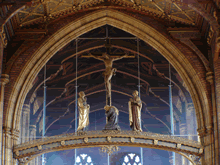
Faith · Worship · Community

All Saints Church

Small Heath, Birmingham · The Cathedral of the backstreets

Our parish history

A story of faith. A part of Small Heath.

From a growing industrial neighbourhood to a shared parish life, explore the places, people and changes that shaped our church. Six chapters. One continuing story.

Chapter 01Before the parish
The origins

From farmland to a growing neighbourhood

Small Heath’s story begins in farmland and gathers pace with the growth of industry and housing. New streets and new communities brought the need for new places of worship.

1861The beginnings of the BSA works helped draw employment and housing into Small Heath.
Read the full chapter

In the last quarter of the nineteenth century, the area which includes the present parish became substantially urbanised outwards from the city centre through Digbeth. The development of the Birmingham Small Arms works, from its small beginnings in 1861, provided a magnet for employment and for housing development. By 1868, established on its 25 acre site in Small Heath, it was the largest private arms company in Europe. Other manufacturing companies and building companies such as Bryants progressively established themselves in Small Heath.

From its first mentions as far back as 1461, the area of Small Heath had been largely farmland in the Manor of Bordesley, with the south side of the Coventry Road owned by James Taylor and developed from the 1860's; and the north side owned by Charles Digby, and developed between 1895 and 1915. Many of the streets of that part of the parish - Charles, Mansel, Bankes, Floyer and Dora are named after members of the Digby family

By the 1880's much of the area was fully urbanised with long terraced streets, courtyards and back houses with little alley ways between them, some few of which remain to this day. The area had its better off parts - for example around Small Heath Park; and its rather worse off areas for example around some parts of Dixon Road.

So far as the Church of England was concerned, the major part of what is now Small Heath was originally in the vast parish of Aston. From the first part of the 19th Century it began to be subdivided: from 1846 the parish of St Andrew, Bordesley to the north of the Coventry Road was created; subsequently much of the rest of Small Heath became the parish of All Saints which was said to have had a population of some 18,000 in 1890.

Two new mission parishes were created out of the old All Saints parish whose church building was in Oakley Road. First came St Aidan's in 1891, initially as a Conventional District and perpetual curacy. Also from the south eastern part of the old All Saints parish a mission chapel of the Good Shepherd (known as an "iron church" from its construction) was created at the turn of the century in 1900; in turn it was demolished and the Church of St Gregory the Great began life as an independent parish.

A third mission parish of St Oswald of Worcester, also initially a small "iron church" had been created in 1882, but this time out of the parish St Andrew's, Bordesley. It was from St Oswald that the next parish along - St Benedict - was created in 1898.

By the early part of the twentieth century, Small Heath consisted of three parishes - St Aidan (though technically initially a Conventional District), St Oswald, St Gregory (whose building was constructed in two stages before and after the Great War and never completed), and part of two others: All Saints and St Andrew. It was a time of rapid growth in the "Churching" of the area, and a time in which the Church enthusiastically responded to the vast changes going on in the community around it. The Churches' response - and this included the Roman Catholic and Baptist Churches who built at the same time - provided a solid foundation for the next seventy years until the 1970's when again vast change overtook the area.
Chapter 021861–1909
Faith takes root

A church among the backstreets

The early story of St Aidan’s is bound up with the renewal of the Catholic tradition in the Church of England: bringing worship, beauty and pastoral care into a rapidly changing urban community.

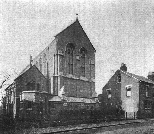
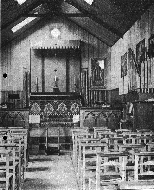
Archive photograph from the early St Aidan’s chapter.
Read the full chapter

A word about one aspect of Church history of the time may be helpful at this point, as it is not possible to understand the development of the Small Heath Churches without knowing something of the renewal of the catholic tradition in the Church of England.

Often dated from the 'Great Assize' sermon by John Keble at Oxford in July 1833, and associated with names such as Newman, Pusey, Liddon and others, the 'Oxford Movement', or 'Tractarians' sought to re establish within the Church of England an acceptance that it was, as it had always been, the true catholic faith of the land since the coming of Augustine and Aidan.

There was much controversy, including court cases and imprisonings. But the catholic movement rooted itself firmly in the worst urban areas of the country - the east end of London, the north west of the country and here in the east side of Birmingham in the parishes of Holy Trinity, Saltley (St Saviour), Sparkhill (St Agatha), Highgate (St Alban), Small Heath (St Aidan, St Oswald, St Gregory and St Benedict) and many others besides - the 'biretta belt' as it became known later on.

The Church was to live out the incarnation in the worst places, bringing light, beauty and truth and humanity into drab places and lives. That was and is the guiding idea of the catholic tradition in the Church of England.

The founder and first priest of St Aidan was the Revd James Agar Ellis, represented in the west window of this present building, holding a model of St Aidan's church.

Iron Mission Church

A small mission church was quickly built in the garden and a photograph of it survives to this day. Loasby, who was for many years a churchwarden, describes it in his 1921 book as:

'a simple oblong building with no ornament except a few bold prints...the altar was large and well lighted, with quiet coloured hangings, a small uncased organ stood out from the wall near the chancel step, and the long narrow mission church, which could accommodate about 200 people, was bright, airy and very peaceful'.

The building was located on the site of the present All Saints Church.

Because of the Church's love for the people and its desire to serve their whole needs, spiritual and physical, the congregation grew rapidly and by July 1893 it was resolved to begin the building of a permanent church.

Loasby describes their feelings: 'the time had come to leave the dear little place where many had so learned the truth of God's love that all the changes and chances of many years of varied life have not dimmed the joy which those truths bestowed...'

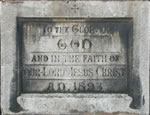
Original foundation stone

St Aidan's church was built on virtually the last remaining space in Herbert Road, in a garden left in the midst of the surrounding houses and to a considerable extent at the hands of parishioners themselves.

Old church building

It was not long however, before the congregation had grown to such an extent that it was decided to extend the building further to the west end. This was largely completed by Christmas 1898 and included the bell tower ('in the desert a voice cries aloud') and the baptistery.

Thomas Frederick Proud was the chosen architect. He died in January 1901, not very long therefore after the church was completed.

Some decorative features of significance were placed in the building at this time, notably in 1907, the Good Shepherd window in the Guild Chapel by Bentram Lamplugh of The Birmingham School of Art.

Canon Newell Long succeeded Fr Agar Ellis at the end of 1901 and development continued, including a new clergy house designed by Arthur Dixon.

Dixon is better known for St Basil's church, Deritend, St Andrew's Barnt Green and other Arts and Crafts works.

Chapter 031910–1969
Worship & craftsmanship

A building shaped by devotion

From 1910, a new phase of decoration transformed the church interior. Screens, choir stalls and other carefully crafted features helped create the building’s distinctive character.

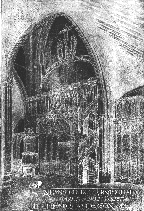
Historic design for the proposed chancel screen.
Read the full chapter

In 1910, some seventeen years after the first dedication, a new phase was entered during which some of the now familiar and much loved decorative features were added to the church building under the supervision of Frederick Bligh Bond and his partner Ellery Anderson.

Although we do not have an account of Fr Newell Long's overall vision for the decoration of the church, we can see its component parts through correspondence with the architect and in the context of the Faculty Petition in which the PCC petitioned 'To erect and place a Rood screen in the chancel; to place new choir stalls in the chancel; to remove the present organ for the purpose of rebuilding the same in a new chamber; to place screens in the arches north and south of the choir'.

The Proposed Chancel Screen

In fact Canon Long with Bligh Bond had a far more extensive scheme in mind to place a highly elaborate screen and loft across the entire chancel arch...

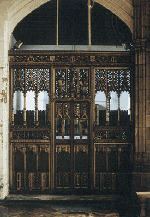
The present screen to the Guild chapel was added in 1914, designed by Bligh Bond.

An extensive scheme for a new east wall reredos was also designed at this time...

None of this was achieved and it was therefore only the Rood Beam and figures that were placed in 1910-1912.

At the same time, in 1910-1912 the Lady Chapel was created.

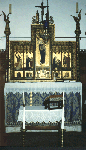
The Reredos in the Lady chapel

Within the Lady chapel a new reredos, the work of Martin Travers and Robert Hitch, was created and commemorates Thomas Proud, the architect.

The Entrance Screen

1921, a quarter of a century and a World War after the dedication of the church, a further stage was reached...

The Rood Beam

In October 1921, a new reredos was put in place and dedicated. It is free standing and seems like the rood beam originally intended...

Fr Long left the parish shortly after the dedication of the reredos and although there continued to be correspondence nothing further was ever done.

Chapter 041910–1969 · continued
The story continues

Beauty in every detail

The second part of this chapter continues the story of the church’s interior, including the carving, decoration and gilding that contributed to its remarkable atmosphere.

The rood beam, shown here in a photograph from the parish archive.
Read the full chapter

The reredos was erected under Ellery Anderson acting on his own since the partnership with Bligh Bond had long since ended; the work was undertaken by Messrs Mowbray and Co of Oxford.

The evidence for this is based upon the original correspondence, including estimates, between Fr Long the then vicar of the church, and Ellery Anderson.

There is in addition the original press clipping of 15th October 1921 at the time of the dedication, which reads inter alia: "The design is that of Mr Ellery Anderson and the work has been admirably carried out by Messrs Mowbray and Co of Oxford" .

It is considered that the reredos is certainly by Mowbrays possibly to the design of W H Randoll Blacking, a disciple of J Ninian Comper, with the carving by Jethro Harris and the decorating and gilding by Edward Simpson.


The history of the first thirty years of the church is therefore one of continual change:
  • The building of the iron mission church in 1893
  • The demolition of the mission church and the building of the first portion of St Aidan's in 1896
  • The building of the second west end portion of St Aidan's in 1898
  • The building of a new clergy house in 1904
  • The placing of new windows in the Guild chapel in 1907
  • The addition of the Rood Beam, Lady chapel and organ loft in 1910-1912
  • The installing of the Guild chapel screen in 1914, although its intended colouring was never completed
  • The alteration to the high altar steps around 1918
  • The addition of the high altar reredos in 1921
  • The paneling of the Lady chapel in 1934
  • The redesign of the organ in 1954

The end result was a building described by Betjeman as: 'successful Perpendicular design in red brick and terra cotta. Tall and spacious with a broad chancel' and by Pevsner as 'a striking and successful example of the local red brick and terra cotta school ... with an atmosphere much encouraged by the splendid Rood and Screens'.

These features, which have been described by the Victoria Society as producing a building 'of very considerable merit and of more than local importance. It is one of the six or seven finest Victorian churches in Birmingham' , resulted in the church building being given a Grade II* listing status in 1970.


The construction and decoration of the building, largely completed by the 1920's had from the beginning been marked by doctrinal difficulties...

Fr Simmonds himself describes his incumbency as a transitional period between the 'almost legendary days' and the present day.

Congregations it is recorded, became low and in the immediate post war years 'Church life was at a low ebb and there were no signs of that great return to religion which some had predicted'.


Following the destruction of its church building by bombing during the war, the former parish of All Saints, the mother parish of St Aidan's, was discontinued and divided between St Aidan's and St Gregory's.

Even if the numbers in the congregation were not high in the latter period, the parish church was nevertheless the place for baptisms, marriages and funerals...

From the mid 1950's Christian people from the Caribbean began to come to the parish and to join the congregation and are today a central part of the life of the Church.

Chapter 051970–1992
A changing Small Heath

Faith through profound change

Industrial decline and the clearance of surrounding streets reshaped the parish. Congregations faced the challenge of maintaining their shared life as familiar neighbourhoods were dispersed and rebuilt.

1973The collapse of BSA marked a major change in the area’s industrial life.
Read the full chapter

It was however, at the end of the 1960's and the beginnings of the 1970's that a wave of change began to take place in Small Heath which has come to alter almost every aspect of the community and therefore of the life of the Church. The historic industrial base of the area began to deteriorate, and the car and component industries that had grown up between the wars began to experience difficulties. The BSA collapsed in 1973 and the employment prospects as well as the physical fabric of the area began to fail. In 1975 the City Council approved a programme of local District plans, including one for Small Heath which had been designated as part of the Birmingham Inner Area Study which reported in 1977. By then substantial areas of housing had been demolished and cleared and even in 1981 it was estimated that 10% of Small Heath remained derelict and unused.

Total Demolition.....
A Planning map of 1971 shows the immediate area surrounding St Aidan church, overlaid with dramatic phrases such as 'demolished' or 'park redevelopment' or 'home for handicapped children'. It also shows the names of the now vanished streets immediately adjacent to the church. Nos 1-13 of the Limes lined the north side; the backs of Nos 1-6 Albert Terrace and No 13 Windsor Terrace and No 14 Osborne Terrace extended the length of the south side within ten feet of the church wall; to the west were the backs of Nos 168 - 182 Arthur Street; and immediately opposite the east end were Nos 159-163 Herbert Road, 159 being the corner house with Chapman Road. Adjacent to the Vicarage was of course No 170. No 172, the present vicarage, was the only one out of 182 houses which remained undemolished in the small area outlined by Herbert, Butler, Arthur and Jenkins Streets.

The programme of demolition following compulsory purchase, engulfed almost every house in St Aidan's parish. A quick glance at the street map of 1960 and 1980 shows the enormity of what was done. The entire community was dispersed to other parts of the city and although many members of the congregation continued to return for worship in St Aidan's, the basis of the Church as a local parish community was seriously undermined, to the extent that by 1995 only 9 communicant members of St Aidan's lived within the former parish.

Slow rebuilding.....
The rebuilding of the area was slow and resulted in a quite different community than previously. Now there is a mix of hostels, mental health provision, sheltered accommodation for elderly people and some residential housing. The roots of the community had been pulled up and in its place a fragmented and to some considerable extent transient population, took its place. A church building which had been slotted into the midst of a residential area in the 1890's had become a church building completely cut off from any housing - surrounded by a health and mental health centre, a park and supported housing for mental health sufferers. From being at the heart of the community, it now had its back to the community.

Ethnic and religious change.....
These were not the only changes to take place in the Small Heath parishes. In some ways an even more profound change was taking place in the ethnic and religious composition with the arrival of muslim people from south Asia, notably Pakistan and Bangladesh, but from other areas as well. The first generation were largely from rural areas and under the stresses of settling in this country, needed to be able to re establish a degree of continuity of culture and religion. Small Heath, with neighbouring areas of Saltley and Sparkhill, Sparkbrook, have become major centres for south asian origin muslim communities in a remarkably short timescale. A street census using the 1997 Electoral Register shows that about 25% of streets in Small Heath have over 60% of adult residents of muslim origin. Overall the adult and child population of muslim faith now makes up not less than 65% of the parish population. The majority of schools in the parish have over 90% of muslim pupils.

There are now more than fifteen mosques in the parish, including the largest in the city and also the first Shia mosque in Small Heath, now completed opposite St. Aidan (at that time).

Chapter 061993–2002
A shared future

The parish comes together

Following the amalgamation of St Aidan, St Gregory and St Oswald in 1992, the next chapter describes the decisions, consultations and practical work involved in shaping a shared parish life.

17 November 1992The parish account records the confirmation of the amalgamation at Buckingham Palace.
Read the full chapter

The result of all these changes on the Church communities of Small Heath was of course dramatic with congregations in each of the parishes falling to very small numbers.

Discussions took place as early as the 1970's about bringing the parishes of St Aidan, St Oswald, St Gregory and St Andrew together and for a period from the mid 1980's they became a Group of parishes.

However the effects of the changes continued, St Andrew's church was demolished and its area divided between St Martin in the Bull Ring and St Aidan.

In 1992 the remaining three parishes were amalgamated into a single parish, though still with three church buildings.

On 17th November 1992 the amalgamation of St Aidan, St Gregory and St Oswald was confirmed at the Court of Buckingham Palace.

From 1994 decisions were taken that there was need for only one set of buildings and a very extensive process of analysis and consultation was undertaken by the parish to determine the Way Forward.


The outcome was a radical set of decisions:
  • To be involved in four new ways in the community together with other local Churches and community organisations
  • To close and sell St Gregory the Great and its vicarage
  • To close and sell the church, hall and vicarage at St Oswald of Worcester
  • To redevelop the St Aidan site
  • To rename the parish as All Saints
  • To bring into the parish the remainder of the former St Andrew's parish, now known as Bordesley Village
  • To purchase a new Vicarage in Bordesley Village

Each of these required very extensive legal, consultative and financial proceedings, which were largely completed by the end of 1998.


The decision to redevelop St Aidan's was based on its location in the parish and its potential for redevelopment.

The changes involved reversing the direction of worship, making the former baptistery into a sanctuary, and creating new entrances and community facilities.

These proposals were supported by several advisory bodies but opposed by others, leading to a Consistory Court case in 1998.

The Chancellor granted a faculty and criticised the Victorian Society’s opposition.


In August 1999 the former vicarage was converted into a community centre.

The redevelopment (1999–2001) included reversing the interior layout, creating new spaces, upgrading infrastructure, and improving access and facilities.


The old hall behind the church was demolished and replaced with a new clergy house and garden area.

The new Clergy House is now occupied by the current parish priest of All Saints.

The story continues
with our community.

Today’s parish life is part of that same story of worship, welcome and care for Small Heath.